Your teenager has spent years learning to look fine. Their teachers may have no idea.
By the time a student with 22q11.2 reaches high school, the mask is well-practised. They copy from the board without understanding. They nod. They submit work that costs them three times the effort it costs a classmate. And they do this quietly, without complaint, often in front of a different teacher every period, none of whom has the full picture.
If school tells you your teenager had a good day while you are managing a shutdown or meltdown at home, you are not misreading your child. What a teacher sees and what you see at home are often genuinely different, and both are real. Your teenager is not being difficult at home and cooperative at school. They are spending everything they have on getting through the school day, and letting go the moment they are safe enough to. That is not a behaviour problem. It is a coping strategy, and understanding it changes everything about how a teacher can help.
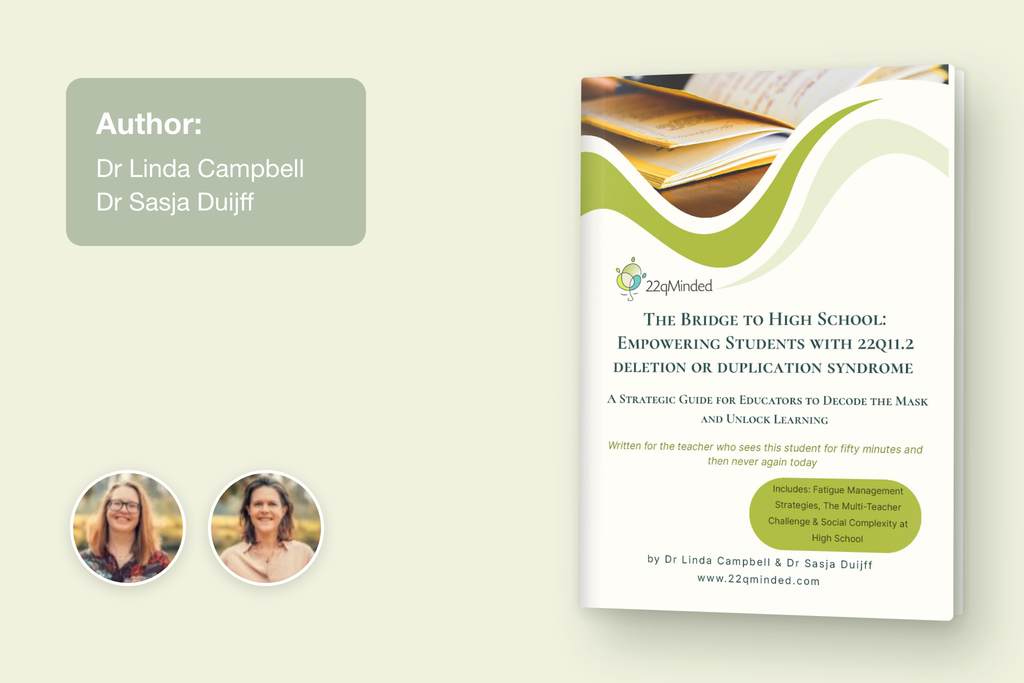
This guide gives you something practical to share with the people who teach your child. Whether your teenager attends a mainstream high school with multiple teachers, a smaller specialist setting, or has just one or two key adults supporting them, this guide explains what is really happening beneath the surface, what it looks like in the classroom, and what an educator can actually do.
What’s inside
- The Short Version: a quick-reference table designed specifically for the secondary school context, including the multi-teacher challenge, fatigue across the school day, and frequent absences
- The Four Things Most Likely to Help, reframed for the secondary classroom
- The Student Passport: a self-advocacy tool your teenager completes themselves and shares with the teachers they choose, helping them communicate their needs in their own words
- In-depth pages on processing and communication, executive functioning in the classroom, executive functioning in homework and assessment, handwriting and written assessment, mathematics, social connection, mental health in adolescence, fatigue, sensory profile, and trauma sensitivity
- Includes high school-specific content on examinations and assessment provisions, assistive technology, modified curriculum pathways, and the school-home gap
About this guide
Written by Dr Linda Campbell, clinical psychologist, and Dr Sasja Duijff, paediatric psychologist, who together bring more than 20 years of experience supporting students and families living with 22q11.2 deletion and duplication syndrome.
- 21 pages, designed to be read in sections
- Suitable for mainstream high schools, specialist settings, and smaller support environments
- Covers both deletion and duplication syndrome
- Practical strategies throughout, with a focus on what educators can realistically do
They may not ask for help. But they will remember the teacher who noticed.