
Your child’s teacher wants to help. They just don’t know what they can’t see.
Children with 22q11.2 deletion or duplication syndrome often look fine from the front of the classroom; they nod, they sit still, they follow along. What’s harder to see is how much energy that takes, and how little is left over for actually learning. A teacher who doesn’t know this will interpret the quiet as coping. It rarely is.
If your child holds everything together at school and falls apart the moment they walk through your front door, you are not imagining it. Both things are true at once. School and home are not showing you two different children, they are showing you the same child coping in two different ways. The classroom version is managing. The home version is recovering. This guide helps a teacher understand what that costs.
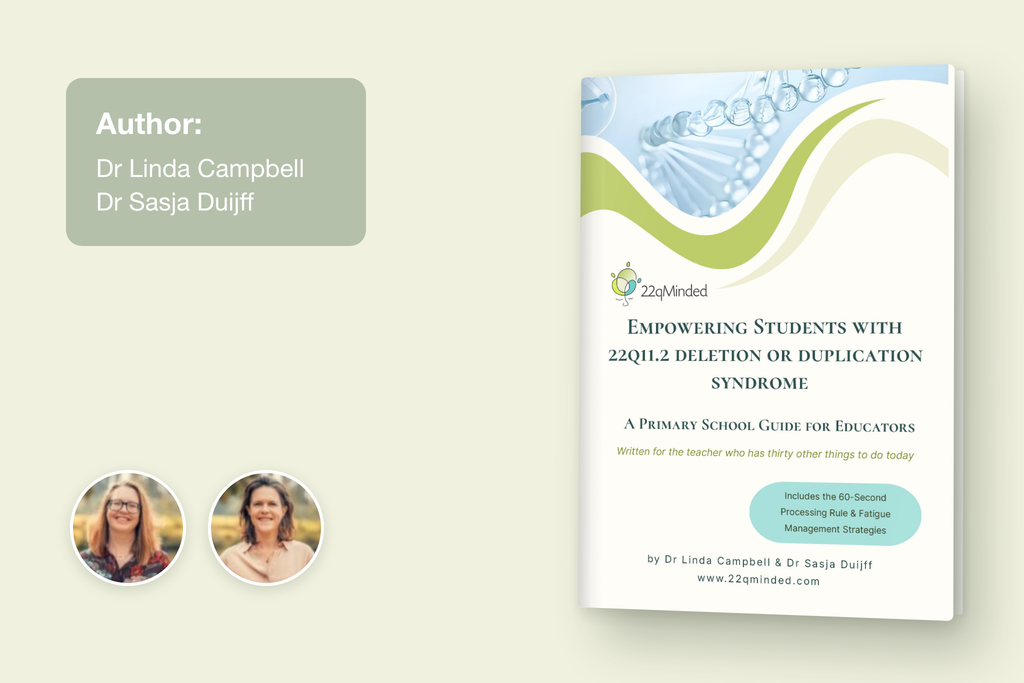
This guide gives you something practical to put in their hands. It explains what is really happening for many children with 22q11.2, what it looks like in a classroom, and what small adjustments make the biggest difference, written for a teacher who has thirty other things to do today.
What’s inside
- The Short Version: a quick-reference table of what a teacher might see, what it might mean, and what to try, designed to be useful immediately
- The Four Things Most Likely to Help: practical, grounded in the research, and easy to act on
- All About Me: a fillable page for your child, you, and their teacher to complete together so the teacher understands your child as an individual, not just a diagnosis
- In-depth pages on processing and communication, executive functioning, mathematics and spatial learning, social and emotional wellbeing, fatigue, sensory profile, and trauma sensitivity
- Includes the 60-Second Processing Rule and Fatigue Management Strategies
About this guide
Written by Dr Linda Campbell, clinical psychologist, and Dr Sasja Duijff, paediatric psychologist, who together bring more than 20 years of experience supporting children and families living with 22q11.2 deletion and duplication syndrome.
- 18 pages, designed to be read in sections rather than all at once
- Written for classroom teachers, learning support assistants, school psychologists, and school leaders
- Covers both deletion and duplication syndrome
- Practical strategies on every page
If they can see it, they can process it. If you wait for them, they can reach you.